The digital world is singing a new song, folks, and it’s powered by AI. We’re not just talking about smarter chatbots here; we’re witnessing a fundamental platform shift, a seismic tremor that’s reshaping everything we thought we knew about technology. It’s like the invention of the internet itself, but faster, and with more blinking lights. And right in the thick of it, a chilling new symphony is being conducted: Akira ransomware.
Most reports slap you with the headline: “Ransomware strikes! Pay up!” They focus on the theatrics – the ominous ransom note, the confetti of encrypted files. But that’s like reviewing a symphony by only commenting on the final cymbal crash. The real magic, and the real danger, happens in the quiet build-up, the complex dance of infiltration that precedes the chaos. This is where the forensic detectives, armed with little more than firewall logs and Windows event data, find the golden nuggets of truth. This isn’t about the binary firing; it’s about the days leading up to it, the silent footsteps across your network. And that’s precisely what this deep dive into a recent Akira intrusion is all about.
The Quiet Invasion: What the Logs Whisper
Imagine your network as a bustling city. The firewall is the border control, the SSLVPN a special express lane for select citizens. What happens when that lane gets compromised? This particular incident paints a stark picture for a mid-sized organization, one that didn’t have the latest high-tech EDR or memory forensics wizardry. Nope. Just the bread and butter: SSLVPN syslog and Windows EVTX exports. It’s a scenario many businesses face, a starting line many find themselves at after an attack. And the joined signal between those two log sources? It’s like finding the attacker’s footprints in the mud that bridges your city’s perimeter to its interior.
The setup here was pretty standard: a single-site Active Directory forest, a perimeter Next-Generation Firewall, and that SSLVPN gateway. Seven days of firewall logs detailing authentication, intrusion prevention, and traffic categories. Event logs from domain controllers and member servers, covering Security, System, and PowerShell operations. And, of course, the ransom note and a smattering of encrypted files, mostly for confirmation. No EDR. No packet captures. Just the essential records. This is the proving ground where the real detective work happens.
Stage 1: The Ghost in the Machine
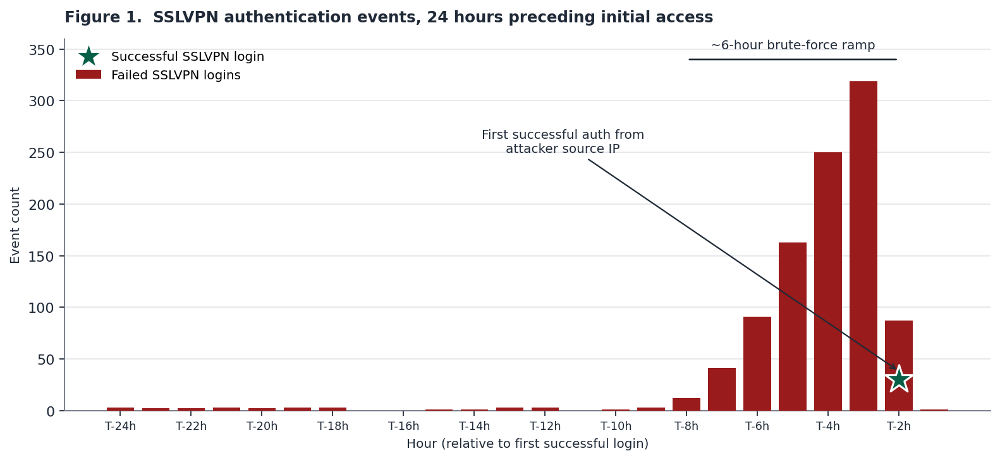
It all started with a whisper from the firewall’s authentication log. Looking at the 72 hours before the encryption event, a blatant brute-force pattern emerged. Not a sophisticated, distributed assault, mind you. Every single failed attempt came from one IP address, lurking in a hosting provider’s range. A single IPS rule or a geo-block could have slammed the door shut. But here’s the kicker: the successful login? It landed squarely in the ramp-up period. No hesitation, no probing. The attacker didn’t pause to test the stolen credential; they walked straight in once they found a match. This isn’t just sloppy security; it’s the behaviorial fingerprint of credential stuffing, like a burglar trying every key from a known stolen keychain.
And the account targeted? It was a local SSLVPN account, disabled in Active Directory but somehow still alive and kicking on the firewall itself. No multi-factor authentication, no extra layer of defense. Its password, a relic of a forgotten security policy, survived a six-hour online assault. It’s a chilling reminder that the simplest vulnerabilities can be the most devastating.
The attacker walked straight in once one matched. That is the behavioral fingerprint of credential stuffing against a known target.
The Silent March: Discovery and Compromise
Once the attacker had their keys to the kingdom, they had a direct path into the user VLAN. The critical pivot point, the clue that bridged the external breach to internal activity, was the firewall’s NAT log. This gave our investigators the post-VPN source IP and the precise time window. They then cross-referenced this with the Windows Security channel. The first internal events of interest were EID 4624 logons – legitimate logins, from the VPN-assigned IP, hitting a jump host. A machine that legitimate remote administrators actually used. Ouch.
What followed was textbook reconnaissance, a methodical survey of the digital landscape. Every step was meticulously logged in EID 4688 process creation events. About 24 hours later, a flurry of EID 4769 events appeared – Kerberos tickets, all RC4-encrypted, all originating from that jump host, all within a 90-second window. This specific combination is the siren song of Kerberoasting, a technique that’s surprisingly easy to detect if you’re listening. It’s the cheapest, most accessible early warning system any Active Directory-joined organization can deploy.
Stage 4: The Shadowy Network Dance
Lateral movement, the attacker’s crawl across the network, unfolded over two days, primarily using Remote Desktop Protocol. The tell-tale sign here? Clusters of EID 4624 Logon Type 10 events. Successful logins originating from the jump host, targeting the file server, both domain controllers, and even the backup server. EID 4672 events followed each domain controller logon, a grim announcement that the attacker now held domain-level privileges. This is where the game truly shifts.
Two details from this phase are particularly telling. The attacker didn’t just create a new account; they created it in a non-default Organizational Unit. More importantly, they added it to a built-in group using its Well-Known SID, bypassing the localized group name. This isn’t the work of someone casually browsing; it’s the sign of an operator scripting for environmental portability, not fiddling interactively in the local language. Think of it like using universal IKEA instructions instead of the Danish ones – efficient, but detached.
And the PowerShell sessions? Several ran with the -EncodedCommand flag. Once decoded, these commands revealed reconnaissance against the backup infrastructure and shadow copy states – a clear pre-staging for the eventual encryption and data exfiltration. This is the kind of activity that should trigger immediate alarms, a warning sign all by itself.
The Final Countdown: Evasion and Impact
The last 12 hours were a blur of rapid, devastating activity. The security evasion maneuvers and the final impact phase collapsed into a swift, brutal sequence. The pattern of events here underscores the attacker’s deliberate strategy: disable defenses, acquire credentials, move laterally, and then strike with overwhelming force. It’s a playbook that’s becoming distressingly common.
This isn’t just about Akira; it’s about the fundamental principles of network defense in the AI era. The ability to correlate disparate log sources – the perimeter’s watchful eye and the endpoint’s internal whispers – is no longer a nice-to-have. It’s the absolute bedrock of survival. Attackers are increasingly sophisticated, using AI-driven tools themselves to find vulnerabilities and automate their attacks. Our defenses need to be just as smart, if not smarter. This means investing in visibility, in logging, and in the tools and skills to connect the dots before the dots connect to form a ransomware attack.
So, while the headline might be about Akira’s latest conquest, the real lesson is in the unseen battle waged in the logs. It’s a reminder that the future of cybersecurity isn’t just about advanced AI defenses; it’s about mastering the fundamental signals your existing infrastructure is constantly sending. It’s about being a detective in your own digital city, understanding every whisper, every flicker of unusual activity, before it’s too late.
🧬 Related Insights
- Read more: TrueChaos: How a Zero-Day in TrueConf Server Let Hackers Infiltrate SE Asian Gov Networks
- Read more: Germany Names REvil and GandCrab Boss: Meet Daniil Shchukin
Frequently Asked Questions
What does Akira ransomware do? Akira ransomware encrypts a victim’s files and demands a ransom payment, often in cryptocurrency, for their decryption. It also frequently engages in data exfiltration, threatening to leak stolen sensitive information to pressure victims into paying.
Can this attack be prevented with EDR? While EDR (Endpoint Detection and Response) solutions are valuable tools, this specific reconstruction highlights that initial access and lateral movement can sometimes be detected by analyzing firewall and Windows event logs. A layered security approach, including strong logging and correlation, is crucial for comprehensive defense.
How can organizations protect themselves from Akira? Key protections include strong password policies, multi-factor authentication (especially for remote access like SSLVPN), regular patching of network devices and systems, network segmentation, and most importantly, strong logging and regular review of perimeter and endpoint logs to detect suspicious activity early.