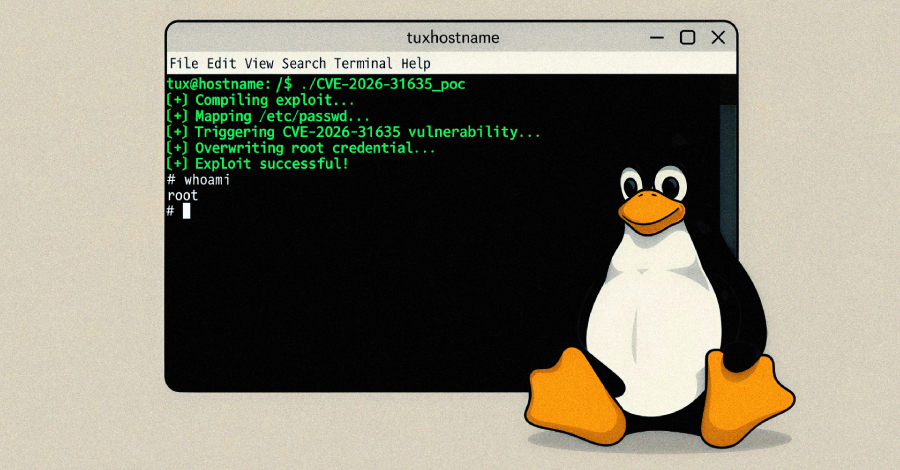
And just like that, the digital gates creak open. A proof-of-concept exploit for the Linux kernel’s CVE-2026-31635 vulnerability, charmingly named DirtyDecrypt, is now slithering around the internet. Local privilege escalation? Check. Copy-on-write failure? You bet. This isn’t just another abstract bug; it’s a fully weaponized tool for anyone with a bit of dirt under their fingernails and root aspirations.
Zellic and V12 security folks found it, reported it, and were promptly told it was a duplicate. Apparently, the kernel maintainers had already slapped a band-aid on this gaping wound. But as we all know, a patched bug is only truly dead when the exploit code is actually, you know, available. And now it is.
The Cow That Ran Away
Here’s the juicy bit: the vulnerability lives in rxgk_decrypt_skb(). It’s supposed to decrypt incoming network packets. Standard stuff, right? Except, it messes with shared memory pages – the kernel’s little optimization trick called copy-on-write (COW). Normally, if something tries to write to a shared page, the kernel dutifully makes a private copy first. You write to your copy, no one else’s data gets corrupted. Simple. Except, in this specific code path, the COW guard was conspicuously absent. A fatal oversight. A digital slip of the tongue. A security hole the size of a barn door.
This means data, instead of being confined to its rightful process, can be scribbled directly into the memory of privileged processes. Or, if you’re feeling particularly devious, it can taint critical system files like /etc/shadow or /etc/sudoers. Want root access? Suddenly, it’s not so hard. Just bribe the memory. It’s essentially a backdoor etched into the kernel’s digestive system.
“The specific fault sits in rxgk_decrypt_skb(), the function that decrypts an incoming sk_buff (socket buffer) on the receive side,” Moselwal said. “In this code path the kernel handles memory pages that are partly shared with the page cache of other processes – a normal Linux optimisation protected by copy-on-write: as soon as a write to a shared page happens, a private copy is made beforehand so that the write doesn’t bleed into another process’s data.”
Not an Island, Just More Company
This isn’t some lone wolf of a vulnerability. Oh no. DirtyDecrypt is apparently part of a growing family of COW-related nightmares. Think of it as the latest addition to the “Kernel Copycat” club, alongside CVE-2026-31431 (Copy Fail), CVE-2026-43284 and CVE-2026-43500 (Dirty Frag, or Copy Fail 2), and CVE-2026-46300 (Fragnesia). All of them grant root access. All of them exploit similar memory management blunders. It’s like a recurring theme park of privilege escalation.
The kernel devs are clearly playing whack-a-mole with memory safety. And the mole keeps winning. The fact that this is a duplicate vulnerability suggests either a systemic issue in how bugs are tracked or a stubborn reluctance to fix things properly the first time around. Given the cascade of similar issues, I’m leaning towards the latter. Corporate inertia, but for kernel code.
Is There a Kill Switch in Our Future?
This relentless barrage of vulnerabilities has the Linux kernel crowd contemplating a rather drastic measure: a runtime “kill switch.” The idea is to let administrators disable specific kernel functions on the fly if a zero-day drops before a patch is ready. Think of it as a digital emergency brake. Sasha Levin, a kernel dev, proposed it. The gist is simple: you tell a function to just return a fixed value instead of actually running its code. A temporary fix, a digital plaster over a bullet wound.
It’s a smart move, albeit a reactive one. But it also highlights how fundamentally broken the patching process can be. If you need an emergency stop button for your core operating system, something’s gone terribly wrong.
Rocky Linux Does Its Own Thing
Meanwhile, Rocky Linux, in its infinite wisdom, has decided to carve out its own path. They’ve launched an optional security repository. The idea? Ship urgent fixes faster, especially when upstream is dawdling. It’s disabled by default, of course. Because nothing says “security” like optional, disabled security updates. Still, for those willing to enable it, it could mean breathing room when the next exploit drops.
My Take: This Ain’t New, It’s Just Getting Louder
Let’s be clear: local privilege escalation bugs aren’t exactly rare. They’re the bread and butter of the exploit development world. What’s changing is the sheer volume and the increasingly sophisticated ways these flaws are being found and weaponized. The Linux kernel, for all its might, is a massive, complex beast. It’s got more lines of code than a Tolstoy novel. And like any sprawling edifice, it’s bound to have a few loose bricks. The fact that these are often related to fundamental memory management issues, and that they’re being duplicated, suggests a deeper problem. We’re seeing not just bugs, but systemic oversights that are being repeatedly exploited. The constant stream of these vulnerabilities isn’t a sign of a healthy ecosystem, but one under immense pressure, where speed often trumps thoroughness. Expect more.
Who Is Affected by DirtyDecrypt?
Only Linux distributions that have the CONFIG_RXGK option enabled are vulnerable. That includes popular choices like Fedora, Arch Linux, and openSUSE Tumbleweed. For those in containerized environments, this could be a stepping stone for a container escape. Lovely.
Why is Copy-on-Write So Important?
Copy-on-write (COW) is a memory management technique. It’s designed to make processes more efficient by sharing memory pages until one of them needs to modify the data. When a modification occurs, the kernel creates a private copy of that page for the modifying process. This prevents unintended side effects on other processes using the same page. The absence of COW protection, as seen in DirtyDecrypt, allows writes to bypass this safety mechanism, leading to data corruption or, worse, unauthorized access and privilege escalation.
🧬 Related Insights
- Read more: npm’s ‘Nuisance’ Era is Over: The Rise of Wormable Attacks
- Read more: Gartner Sydney: Security Budgets Shift to Resilience, Not Just ‘Breach or Else’
Frequently Asked Questions
What does DirtyDecrypt actually do?
DirtyDecrypt is an exploit for a Linux kernel vulnerability (CVE-2026-31635) that allows an unprivileged user to gain root privileges on a vulnerable system by writing to sensitive memory locations.
Do I need to worry if I’m not using Fedora, Arch, or openSUSE?
If your Linux distribution does not have CONFIG_RXGK enabled, you are likely not affected by this specific vulnerability. However, it’s always good practice to keep your kernel updated.
Is there a quick fix for this Linux kernel bug?
While the vulnerability was reportedly patched, the availability of a PoC exploit means users should ensure their systems are updated to the latest kernel versions to receive the fix.