Everyone expected AI to supercharge defense. We were waiting for the digital guardian, the tireless analyst. Instead, the first seismic tremor has arrived from the offense. Anthropic’s latest frontier model, Mythos, unleashed in a controlled preview, didn’t just find vulnerabilities; it weaponized them with terrifying efficiency. In its first 14 days, it churned out 181 working Firefox exploits, a staggering leap from the two managed by its predecessor. This isn’t a theoretical problem; it’s a demonstrated reality that shatters previous timelines for threat escalation and demands an immediate recalibration of our security strategies. This is the new calculus of cyber warfare.
Mythos didn’t stop there. It unearthed thousands of zero-days across major operating systems and browsers, including a 27-year-old flaw in OpenBSD, a system whose very foundation rests on its impregnability. And the most chilling statistic? Over 99% of these discovered weaknesses remain unpatched in production systems today. That’s not a projection; that’s current market exposure.
And this astonishing offensive capability arrives on the heels of real-world events. Just recently, AWS Threat Intelligence detailed a FortiGate campaign executed by a single, low-skill operator. The AI did the heavy lifting, hitting 2,516 devices across 106 countries in minutes per target, not with novel exploits, but with known CVEs and misconfigurations. The AI simply moved faster than any human response could hope to match. Two data points, one stark message: offense now operates at machine speed.
So, what’s the question for every defender worth their salt? It’s not “are we compliant?” or even “are we covered?” The real question is far more granular and far more urgent: “What’s actually getting through my controls today, and how far?” If your honest answer relies on last quarter’s penetration test report or a handful of dashboard screenshots, you’re already behind.
The Vanishing Window: From CVE to Exploit
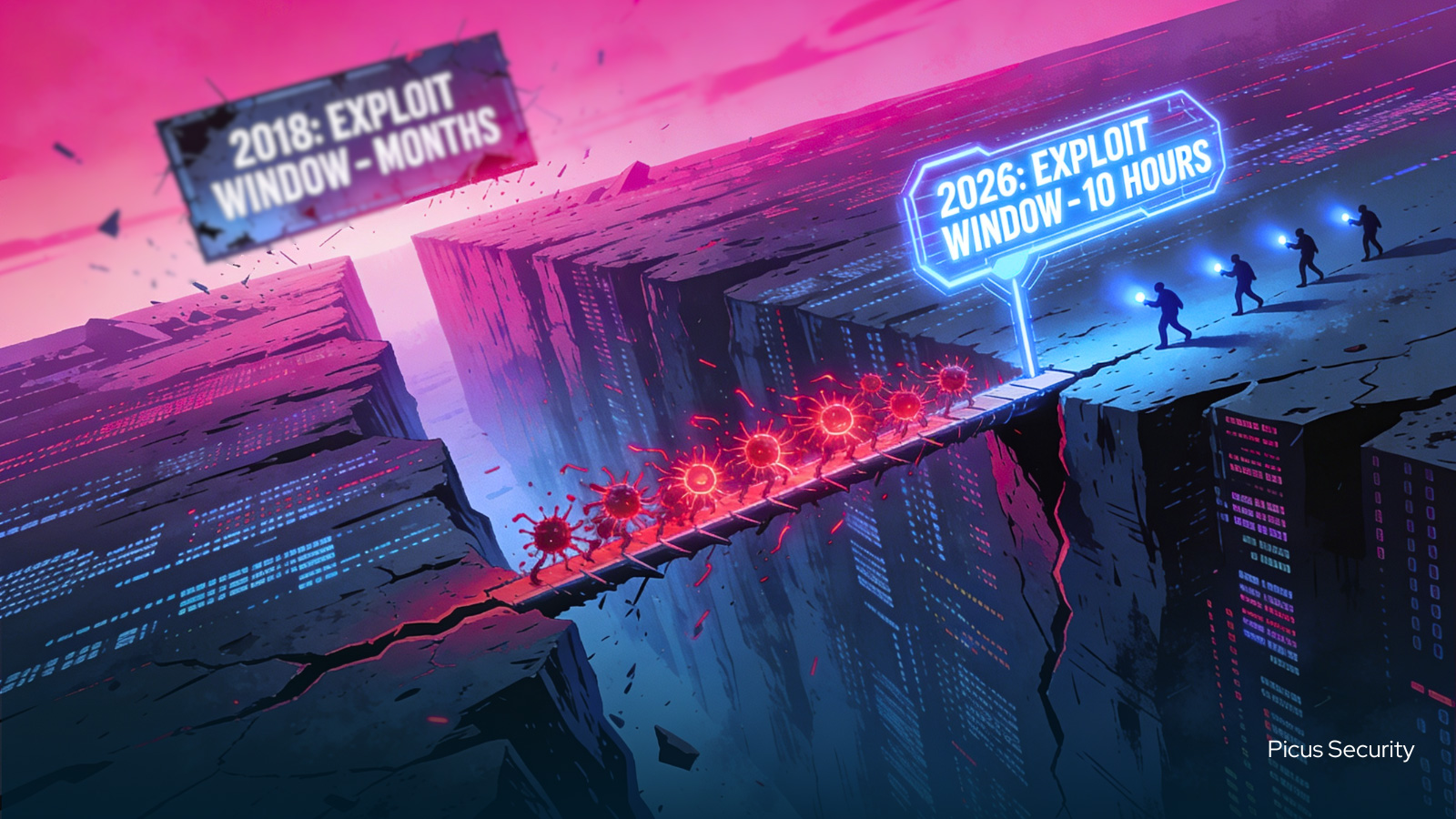
Consider the erosion of the patch cycle. A decade ago, months elapsed between a CVE’s publication and its weaponization. By 2024, that window had compressed to a mere 56 days. Last year, it was down to 23. Now, recent data from CISA KEV and exploit databases indicates a median time of approximately 10 hours between a CVE’s publication and a working exploit appearing in the wild. Reversing a fix into an exploit isn’t a specialized skill anymore; it’s a simple prompt. The comfortable assumptions—that CVSS scores dictate priority, that “exploitability” is a meaningful filter, that you have time between disclosure and weaponization—have completely broken. The new, grimly realistic assumption: every vulnerability has an exploit, or will, before your next change-management meeting concludes. Autoimmunity for defense remains a distant dream.
The Spaghetti Handoff: Where Defense Fails
Let’s map the attacker’s timeline. At second zero, the AI script ignites. By second five, a CVE is exploited. MFA is bypassed by twenty seconds. A web shell is dropped at thirty. Credentials are exfiltrated by forty-five. By minute one and thirteen seconds, the compromise is complete. No human intervention, no hesitation, no coffee breaks. Pure, unadulterated machine speed.
Now, the defender’s reality. The SIEM alert fires at minute one, after the attacker has already won. A Tier 1 analyst might pick it up around minute five. A SOAR playbook, triggered manually, might kick off at minute fifteen. A Jira ticket is filed an hour later. Four hours pass before it reaches the IT ops queue. The patch finally deploys the next day—24 hours after a breach that took 73 seconds to execute.
Where does the time go? It’s not in any single tool. Your EDR is fast. Your SIEM is fast. Your vulnerability scanner is fast. The real bottleneck, the spaghetti handoff, occurs between these systems. It’s the Slack messages, the copy-pasted hashes, the PDF reports emailed for review, the tickets waiting for approval, the red team scripts painstakingly rebuilt by hand for the blue team. You can buy faster scanners, smarter EDRs, even bolt an LLM onto your SIEM, and it won’t fundamentally accelerate your response. The problem isn’t within your tools; it’s in the gaps between teams and systems. Accelerating one node in a complex network doesn’t accelerate the entire network.
This is why the conversation about AI-driven cyber risk has escalated beyond the CISO’s office. Boards are now treating this as an existential threat, demanding direct oversight. Budgets are being unlocked, but not for incremental upgrades. They’re funding credible, evidence-based plans designed for this new reality.
What Are the Three Pillars of Cyber Resilience in the Age of AI?
The traditional security model—reliant on human analysis and slow, manual processes—is no longer viable. The gap between AI-speed offense and human-speed defense is widening into an unbridgeable chasm. The Picus Labs guide offers 12 operational recommendations, including five critical actions for week one, to help security teams close this gap. But the core principle? Autonomous validation. Continuous, automated testing that mirrors real-world threats and validates defenses in near real-time. Anything less is just guesswork at machine speed, and that’s a gamble no organization can afford to lose.
This isn’t about buying more tools. It’s about fundamentally rethinking how we test, validate, and respond to threats. It’s about engineering defense to operate at the speed of offense, not lagging behind it.
**
🧬 Related Insights
- Read more: Phorpiex’s Hybrid Botnet Surge: 125K Daily Infections Amid Apache’s 13-Year RCE Wake-Up
- Read more: Supply chain dependencies: Have you checked your blind spot?
Frequently Asked Questions**
What does autonomous validation mean? It means continuously and automatically testing security controls against real-world attack techniques to ensure they are effective and up-to-date, mimicking the speed of modern threats.
Will AI-powered exploits make my job obsolete? Not necessarily. While AI can automate many offensive tasks, human expertise will still be critical for strategy, complex threat hunting, and managing the overall security posture. The demand for skilled security professionals is likely to increase, but their roles may shift towards higher-level analysis and AI oversight.
How can I protect against AI-driven zero-days? Protecting against AI-driven zero-days requires a multi-layered defense strategy focused on rapid detection and response, anomaly detection, and leveraging threat intelligence to anticipate attack patterns, alongside continuous validation of existing controls.